Notes From The Underground - VII
[Pay Attention]
For the average person, their consumption habits aren't deliberate, their digital environment is on default, and there are a thousand things competing for their attention.
Prolific creators, on the other hand, have gone out of their way to eliminate the competition for their attention and made deep work a big priority in their life.
It takes continuous attention and intense focus to perform at an elite level.
Without the ability to focus on something demanding for an extended period, you're at a disadvantage.
Your attention is worth a fortune. The founders of the major social networks, what author Tim Wu calls the "attention merchants", have become billionaires by getting you addicted to their services and selling your attention to advertisers.
It's worth asking if the amount of your attention you're spending on these digital things is getting you what you want.
If you're convinced that you should be spending your attention on more worthwhile pursuits, it's not enough to implement a bunch of hacks because vague resolutions are not sufficient to tame the ability of new technologies to invade your cognitive landscape- the addictiveness of their design and strength of the cultural pressures supporting them are too strong for an ad hoc approach to succeed.
In other words, all the solutions we use to deal with distractions are band-aids on bullet wounds.
This is why the most effective way to become a digital minimalist is to just quit.
Shallow work like checking email, updating your status or uploading pictures feels productive, but it's not. Run them through this framework: 1 – Is this vital? 2 – Does this matter? 3 – What would happen if I didn't do it?
These things usually aren't vital, don't matter, and nothing would happen if you didn't do them.
I haven't uploaded a picture to Instagram in weeks. Guess what? Nobody cared.
Srinivas Rao (2019)
The quality of life you want for yourself ultimately comes down to how you spend your time and what you give your attention to.
Time is the most valuable asset you have. It's a non-renewable resource you can never get back.
At my very first internship at a startup, the CFO asked me, "Why do you want to make a lot of money?" As a 20-year-old, I rattled off the list of luxuries I was imagining (Ferraris, McMansions, jets, etc).
He said, "You're wrong. What money buys is time. Time is what's really valuable."
Yet people wait to start a business, a project or pursue a dream as if they have all the time in the world.
They waste time doing things they hate or suck at doing. They think there's some mythical date in the future when the conditions will be perfect; the stars will align;, and they'll have enough money in the bank or time to spend on their art.
But the only thing that changes when you wait is that time passes. In order to use your life-fixed time effectively, you need to pay Attention.
It determines the state of our lives, and is under constant assault from social media, inboxes, text messages, pings, pops and buzzes.
Think of your attention as credit that you have every day after waking up and when you spend it on sources of distraction, you don't have it anymore to yours other more meaningful pursuits.
If you want to improve your attention span, start by reducing the competition for it.
If it's not relevant to the task at hand, remove it from your environment. Drown out the sound with some noise cancellation headphones.
And design an environment that's free of distractions.
Srinivas Rao (2019)
[A Linha Urbana de Lisboa]
Existe um consenso atualmente que a linha suburbana é imutável e que serve basicamente para separar o município de Lisboa (o urbano) dos restantes da Área Metropolitana (os subúrbios).
Essa visão está espelhada no mapa de 2014 do Metropolitano de Lisboa:
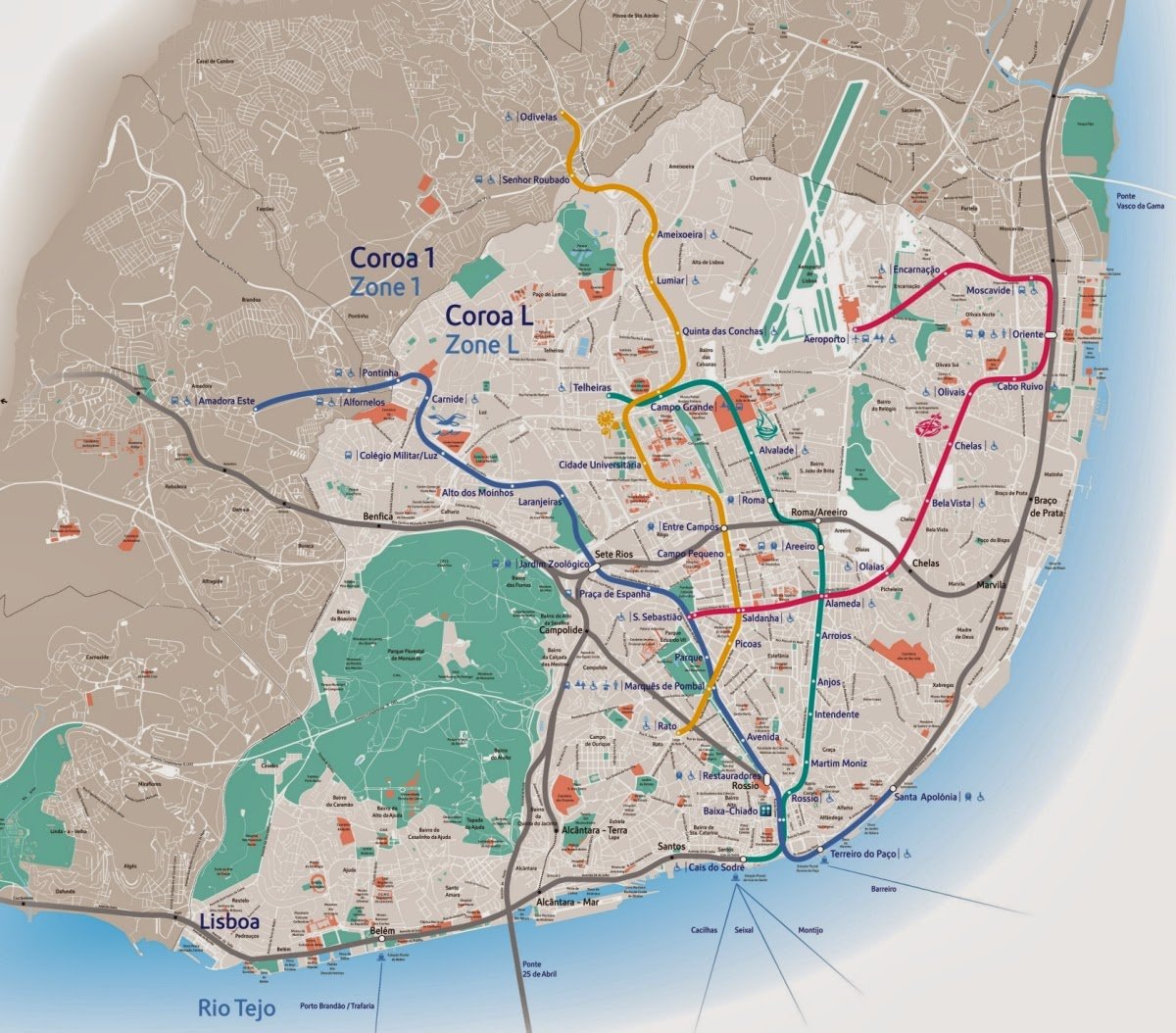 Os limites entre as duas coroas, L para urbano e 1 para suburbano, corresponde à fronteira administrativa do município de Lisboa.
Contudo, se recuarmos um pouco mais de 40 anos, quando ainda se estava a formar a metrópole, já o conceito de urbano / suburbano existia dentro do próprio município de Lisboa como demonstra o mapa da rede do principal meio de transporte na altura, os eléctricos da Carris:
Os limites entre as duas coroas, L para urbano e 1 para suburbano, corresponde à fronteira administrativa do município de Lisboa.
Contudo, se recuarmos um pouco mais de 40 anos, quando ainda se estava a formar a metrópole, já o conceito de urbano / suburbano existia dentro do próprio município de Lisboa como demonstra o mapa da rede do principal meio de transporte na altura, os eléctricos da Carris:
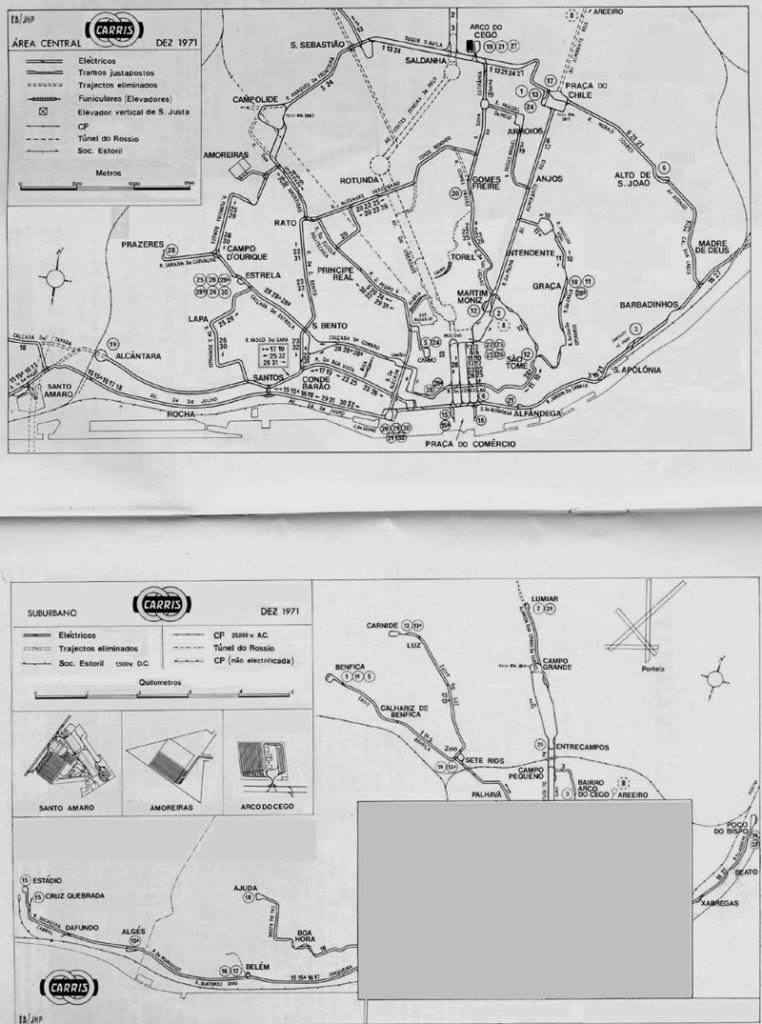 Para a Carris em 1971 os subúrbios começavam a partir do arco formado por Alcântara, Praça de Espanha, Areeiro e Xabregas.
Ou seja, os bairros lisboetas suburbanos das zonas de Benfica, Lumiar, Telheiras, Carnide, Ajuda ou Olivais viram a sua condição mudar para urbanos apenas posteriormente.
Isto demonstra que a divisão urbano suburbano é uma decisão puramente política e administrativa.
Ao analisarmos a fronteira atual depara-se com situações como a linha entre a Amadora e Lisboa onde não existem fundamentos urbanísticos para realizar qualquer divisão:
Para a Carris em 1971 os subúrbios começavam a partir do arco formado por Alcântara, Praça de Espanha, Areeiro e Xabregas.
Ou seja, os bairros lisboetas suburbanos das zonas de Benfica, Lumiar, Telheiras, Carnide, Ajuda ou Olivais viram a sua condição mudar para urbanos apenas posteriormente.
Isto demonstra que a divisão urbano suburbano é uma decisão puramente política e administrativa.
Ao analisarmos a fronteira atual depara-se com situações como a linha entre a Amadora e Lisboa onde não existem fundamentos urbanísticos para realizar qualquer divisão:
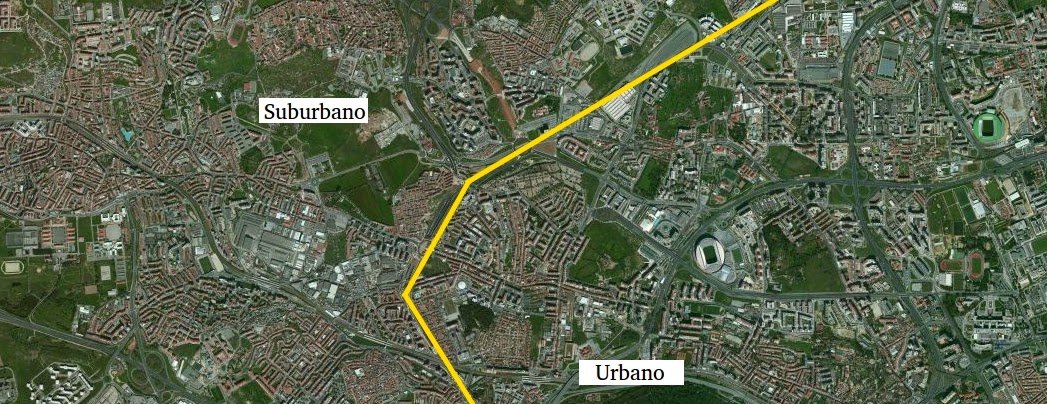 Portanto, as fronteiras urbano suburbano não refletem a realidade da área metropolitana de Lisboa e como tal exigem uma redefinição política das mesmas para passar a incluir territórios dos municípios da Amadora, Oeiras, Sintra, Odivelas e Loures:
 A amarelo encontra-se a fronteira de 1971, a verde a de 2014 e a laranja a proposta de uma nova fronteira: o arco entre Sacavém, Loures, Casal de Cambra, Belas, Massamá e Cruz Quebrada.
(2014)
[America’s White Saviors]
A sea change has taken place in American political life.
The force driving this change is the digital era style of moral politics known as "wokeness," a phenomenon that has become pervasive in recent years and yet remains elusive as even experts struggle to give it a clear definition and accurately measure its impact.
Where did it come from? What do its adherents believe? Is it just something happening inside the Twitter bubble and on college campuses or is it really spreading across the social and cultural landscape and transforming the country as sometimes appears to be the case?
In reality, "wokeness"is a broad euphemism for a more narrow phenomenon: the rapidly changing political ideology of white liberals that is remaking American politics.
Over the past decade, the baseline attitudes expressed by white liberals on racial and social justice questions have become radically more liberal.
In one especially telling example of the broader trend, white liberals recently became the only demographic group in America to display a pro-outgroup bias—meaning that among all the different groups surveyed white liberals were the only one that expressed a preference for other racial and ethnic communities above their own.
Matthew Yglesias described this ongoing transformation as The Great Awokening: "In the past five years, white liberals have moved so far to the left on questions of race and racism that they are now, on these issues, to the left of even the typical black voter."
There is no simple or single explanation for how this process got started.
It appears to be driven by an interplay of factors: preexisting tendencies among white liberals; a series of polarizing events like the police shooting of Michael Brown and subsequent riots in Ferguson, and the migrant crisis; the rise of millenials as a political force, and the explosion of social media and "woke" clickbait journalism.
The years between 2012 and 2016 were a watershed for white liberal racial consciousness. As white liberals have come to place far greater emphasis on racial injustice, they have also endorsed reparative race-related social policies in greater numbers.
This is evident across a range of issues: the rapid growth in white liberals who favor affirmative action for blacks in the labor force; in the increase in white liberals who feel that we spend too little on helping blacks, and that the government should afford them special treatment; in the increase in white Democrats who think it's the government's job to ensure "equal income across all races"; and in the increase in white liberals and Democrats who think that white people have 'too much' political influence.
An example of how these psychological characteristics and moral foundations can be manifested in politics and policy can be seen in the white responses to measures of empathy toward racial and ethnic minorities.
Remarkably, white liberals were the only subgroup exhibiting a pro-outgroup bias—meaning white liberals were more favorable toward nonwhites and are the only group to show this preference for group other than their own.
Indeed, on average, white liberals rated ethnic and racial minority groups 13 points (or half a standard deviation) warmer than whites.
This disparity in feelings of warmth toward ingroup vs. outgroup is even more pronounced among whites who consider themselves "very liberal" where it widens to just under 20 points.
Notably, while white liberals have consistently evinced weaker pro-ingroup biases than conservatives across time, the emergence and growth of a pro-outgroup bias is actually a very recent, and unprecedented, phenomenon.
Not surprisingly, data from the American National Elections Studies (ANES) shows white liberals scoring significantly higher on measures of 'white privilege awareness' and 'white guilt'.
Previous research has shown that these collective moral emotions, triggered by historical wrongdoing and perceptions that an in-group's advantages and privileges are illegitimate, can can increase support for reparative and humanitarian social policies.
That is exactly what has happened in recent years as white liberals have become increasingly supportive of affirmative action, reparations, and increased immigration.
An analysis of GoogleTrends data shows that the frequency of searches for race-related and "woke" terms has grown substantially since the beginning of the decade—a period that happens to coincide with the social media boom and the emergence of so-called hashtag activism (e.g., Occupy Wall Street, Black Lives Matter).
This period also saw the rise of the Huffington Post—an online progressive blog and news site that prolifically opines on race-related issues.
Whereas just 13% of white liberals reported regularly visiting the site in 2012, over 30% did in 2016.
A similar pattern is observed for digital readership of The New York Times (NYT), which grew from 16% to 31% among white liberals between 2012 and 2016—during this same period, according to a recent content analysis I conducted—the percentage of Times articles mentioning race-related and woke terms saw unprecedented growth.
For instance, whereas just 0.4% (or 334) of articles referred to racism in 2012, this figure had doubled by 2015 (to 0.87% or 813) and reached over 2% (or 2,353) by 2018.
Interestingly, the number of monthly NYT articles mentioning racism also closely tracks Google search interest in the term.
Unfortunately, the outrage delivered through digital media tends to distort this vital perspective.
America is perceived as incorrigibly unjust, racist, and in need of radical transformation. Compounding this, the perception of benefiting from such iniquity through white privilege naturally produces heightened feelings of guilt, anger, and an empathic desire "to do something" to help the suffering, or to at least signal one's moral virtue to others.
It's the frustration with white conservatives' inability or reluctance to keep pace with white liberals on the path to enlightenment that is intensifying our political divide.
But conservatives tend toward normative and structural stability. They don't take well to rapid social change.
The perceived imposition and spread of progressive norms naturally elicits psychological reactance—a visceral desire to resist and affirm one's agency in the face of perceived social pressure.
This is the very process that is at least partly responsible for the election of Trump.
Resentment of those seen as standing in the way of necessary social and cultural change may inspire a commitment to what political scientist Eric Kaufman calls "multicultural millenarianism": the belief that the demise of a white majority will pave the way for a more racially progressive and just society.
Perhaps this is why white support for increasing immigration coincides with more negative feelings toward whites.
Whatever the case, such sentiment would have been hard to fathom 10-20 years ago. The digitalization of moral outrage that makes it possible today could, with the pace of innovation, make it even more potent in the years to come.
Zach Goldberg (2019)
[Where Money Comes From]
We still tell kids to go to school, get a job, work hard, save money and get out of debt. Now, who tells them to do that? That's the most ridiculous thing there is! Why would you save it and why would you work for it, if they can print it faster than you can work for it!
[Robert Kiyosaki (2017)]
My novel The Mandibles was taken to task by one reviewer for addressing an America that is "straight and white".
The implication of this criticism is that we novelists need to plug in representatives of a variety of groups in our cast of characters, as if filling out the entering class of freshmen at a university with strict diversity requirements.
You do indeed see just this brand of tokenism in television. In the world of identity politics and cultural appropriation, fiction writers better be careful.
If a character happens to be black, they have to be treated with kid gloves, and never be placed in scenes that, taken out of context, might seem disrespectful.
But that's no way to write. The burden is too great, the self-examination paralyzing. The natural result of that kind of criticism is that next time I don't use any black characters, lest they do or say anything that is short of perfectly admirable and lovely.
I confess that this climate of scrutiny has got under my skin.
Lionel Shriver (2016)
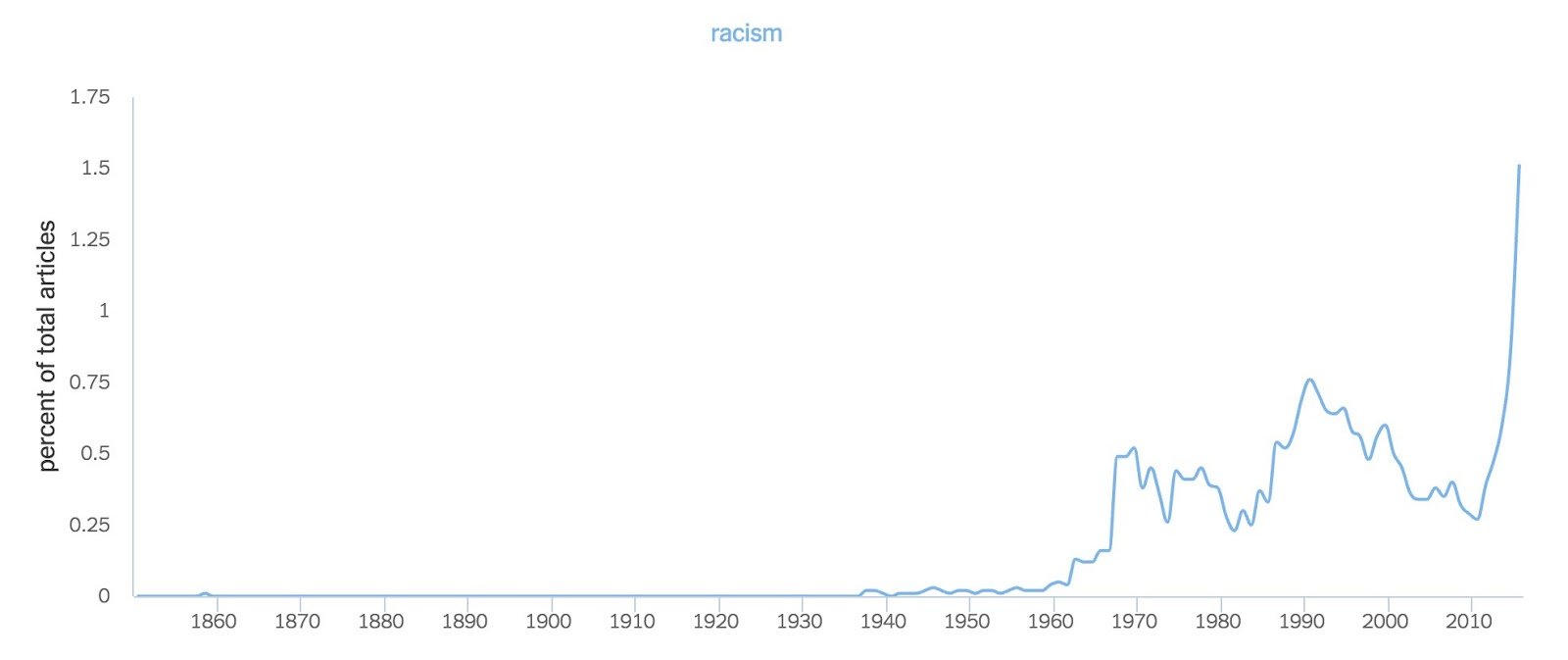 Frequency of the word 'Racism' in New York Times articles, 1851-2016
[Tribal World, Group Identity Is All]
Humans, like other primates, are tribal animals. We need to belong to groups, which is why we love clubs and teams.
Once people connect with a group, their identities can become powerfully bound to it.
They will seek to benefit members of their group even when they gain nothing personally.
They will penalize outsiders, seemingly gratuitously. They will sacrifice, and even kill and die, for their group.This may seem like common sense.
And yet the power of tribalism rarely factors into high-level discussions of politics and international affairs, especially in the United States.
This blindness to the power of tribalism affects not only how Americans see the rest of the world but also how they understand their own society.
It's easy for people in developed countries, especially cosmopolitan elites, to imagine that they live in a post-tribal world.
The very term "tribe" seems to denote something primitive and backward, far removed from the sophistication of the West, where people have supposedly shed atavistic impulses in favor of capitalistic individualism and democratic citizenship.
In recent years, the United States has begun to display destructive political dynamics: the rise of ethnonationalist movements, eroding trust in institutions and electoral outcomes, a popular backlash against both "the establishment" and outsider minorities, and, above all, the transformation of democracy into an engine of zero-sum political tribalism.
These developments are due in part to a massive demographic transformation. For the first time in U.S. history, Whites are on the verge of losing their status as the country's majority.
To varying degrees, minorities in the United States have long felt vulnerable and under threat; today, Whites also feel that way.
A 2011 study showed that more than half of white Americans believe that "whites have replaced blacks as the 'primary victims of discrimination.'"
When groups feel threatened, they retreat into tribalism. They close ranks and become more insular, more defensive, more focused on us versus them.
What happened in the 2016 U.S. presidential election is exactly what I would have predicted would happen in a developing country holding elections in the presence of a deeply resented minority: the rise of a populist movement in which demagogic voices called on "real" Americans to, in Donald Trump's words, "take our country back."
The answer lies in tribalism.
Amy Chua (2018)
[The Post-Western World]
For decades, Yale offered a two-semester introductory sequence on the history of Western art.
The fall semester spanned the ancient Middle East to the early Renaissance; the spring semester picked up from the High Renaissance through the present.
The introductory art history course has been my anchor to the past, providing visual grounding in the development of Western civilization, around which it is possible to develop a broader sense of history.
But now, the art history department is junking the entire two-semester sequence. The reasons given are either laughably weak or at odds with the facts.
The first reason is the most absurd: the course titles ("Introduction to the History of Art: Prehistory to the Renaissance" and "Introduction to the History of Art: Renaissance to the Present").
Art history chair Tim Barringer, whose specialities include post-colonial and gender studies, apparently thinks students will be fooled by those titles into thinking that other traditions don't exist.
"I don't mistake a history of European painting for the history of all art in all places," he primly said. No one else would, either.
But if the titles are such a trap for the Eurocentric unwary, the department could have simply added the word "European" before "Art" and been done with it.
Marissa Bass, the director of undergraduate studies in the department, echoed Barringer's accusation of Eurocentrism.
The changes recognize "an essential truth: that there has never been just one story of the history of art."
Barringer promises that the replacement surveys will subject European art to a variety of deconstructive readings designed to pull that tradition down from its alleged pedestal.
The new classes will consider Western art in relation to "questions of gender, class, and 'race,'" he told the Daily News in an email, carefully putting scare quotes around "race" to signal his adherence to the creed that race is a social construct.
The new courses will discuss the involvement of Western art with capitalism. Most intriguingly, the relationship between Western art and climate change will be a "key theme," he wrote.
Barringer's proposed deconstruction of Western art illustrates a central feature of modern academia: The hermeneutics of suspicion applies only to the Western canon.
Western academics continue to interpret non-Western traditions with sympathy and respect; those interpreters seek to faithfully convey the intentions of non-Western creators and to help students understand what makes non-Western works great.
So, while the replacement European art survey courses will, in Marissa Bass's words, "challenge, rethink, and rewrite" art historical narratives, the department will not be cancelling its Buddhist art and architecture class due to the low representation of female artists and architects, nor will it "interrogate" (as High Theory puts it) African arts and cultures for their relationship to genocidal tribal warfare, or Aztec art and architecture for their relationship to murderous misogyny.
Yale has cancelled other landmark courses on identity grounds.
For decades, English majors were required to take a yearlong course called "Major English Poets."
But that course was defenestrated from its gateway status for English majors in 2017, following a student petition griping preposterously that a "year spent around a seminar table where the literary contributions of women, people of color, and queer folk are absent actively harms all students, regardless of their identity. The Major English Poets sequences creates a culture that is especially hostile to students of color."
Rather than push back against this ignorant nonsense, members of Yale's English faculty validated its premise.
Professor Jill Richards announced that it was "unacceptable that the two semester requirement for all majors routinely covers the work of eight white, male poets."
Jill Richards, who specializes in global modernism, gender and sexuality, citizenship, human rights, critical legal theory, revolution, social movements, cinema, avant-gardes, and young adult literature, is another example of the trahison des clercs: terrifyingly, despite her contempt for "white, male poets," she teaches the now-optional "Major English Poets."
Yale's lust for curricular cancellations has picked up steam since Major English Poets lost its required spot in the English major.
The art history department appears to be eliminating the Western art introductory courses on its own initiative, without the pretext of a student petition or other agitation.
The only possible grounds for doing so is a political hatred for the Western tradition, since the axed courses were voluntary and surrounded by numerous non-Western alternatives.
Barringer did not reveal whether African, Asian, and South American art will now be "problematized" along with Western art.
The one-sided subjection of Western civilization to the petty tyranny of identity politics will only worsen.
Yale is one of four universities to have received a $4 million grant to infuse the theme of race into every aspect of humanities teaching and scholarship.
Brown, the University of Chicago, and Stanford are the other recipients of that Andrew W. Mellon Foundation bequest.
(The Mellon Foundation, once a supporter of apolitical humanities scholarship, has been captured by the identitarian Left.)
Race, Yale announced in its press release about the Mellon grant, is critically important and indisputably central to the humanities.
Heather Mac Donald (2020)
The character of man is empirical: only through experience can one get to know it.
Therefore we are often disappointed with ourselves when we discover that we do not have this or that quality, like justice, selflessness, or courage, in as high a degree as we most indulgently supposed. Hence too, in any difficult choice our own resolve, like that of another person, remains a mystery to us until the choice has been actually made.
Therefore, no one can know how another, and even how he himself, will act in a definite situation, until he has been in it.
It is only out of experience and from opportunities to observe that our acquaintance with ourselves derives, on which self-trust or mistrust is based.
Depending on whether in a given instance we have shown prudence, courage, honesty, discretion, astuteness, or whatever else the case might require, or whether the lack of such virtues has come to light, we are, as a result of the acquaintance made with ourselves, subsequently either satisfied or dissatisfied with ourselves.
Only an exact knowledge of his own empirical character gives a man that which is called an acquired character.
That man possesses it who knows accurately his own qualities, good as well as bad, and thus knows for certain with what he can trust himself, what he can expect of himself, and what he cannot.
The same truth underlies the fact that a man, even in the clearest knowledge and indeed disgust at his moral failures and defects, and in the most sincere intention to reform, still does not really reform but, in spite of serious intentions and honest promises, and to his own surprise, finds himself, when the opportunity recurs, again treading the same paths as before.
[Arthur Schopenhauer (1839)]
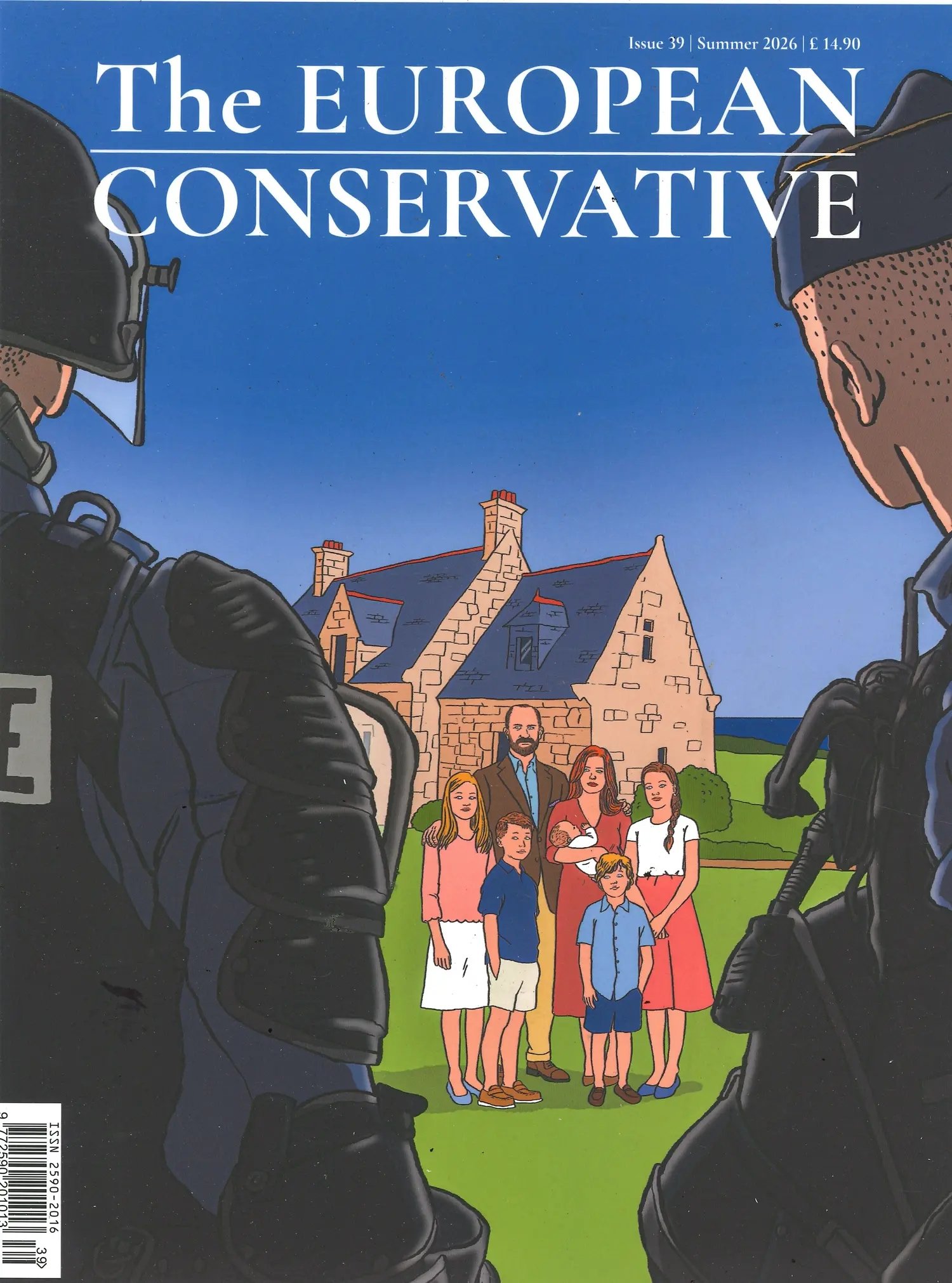
Europe 2026. They are coming.
Your Life in Weeks
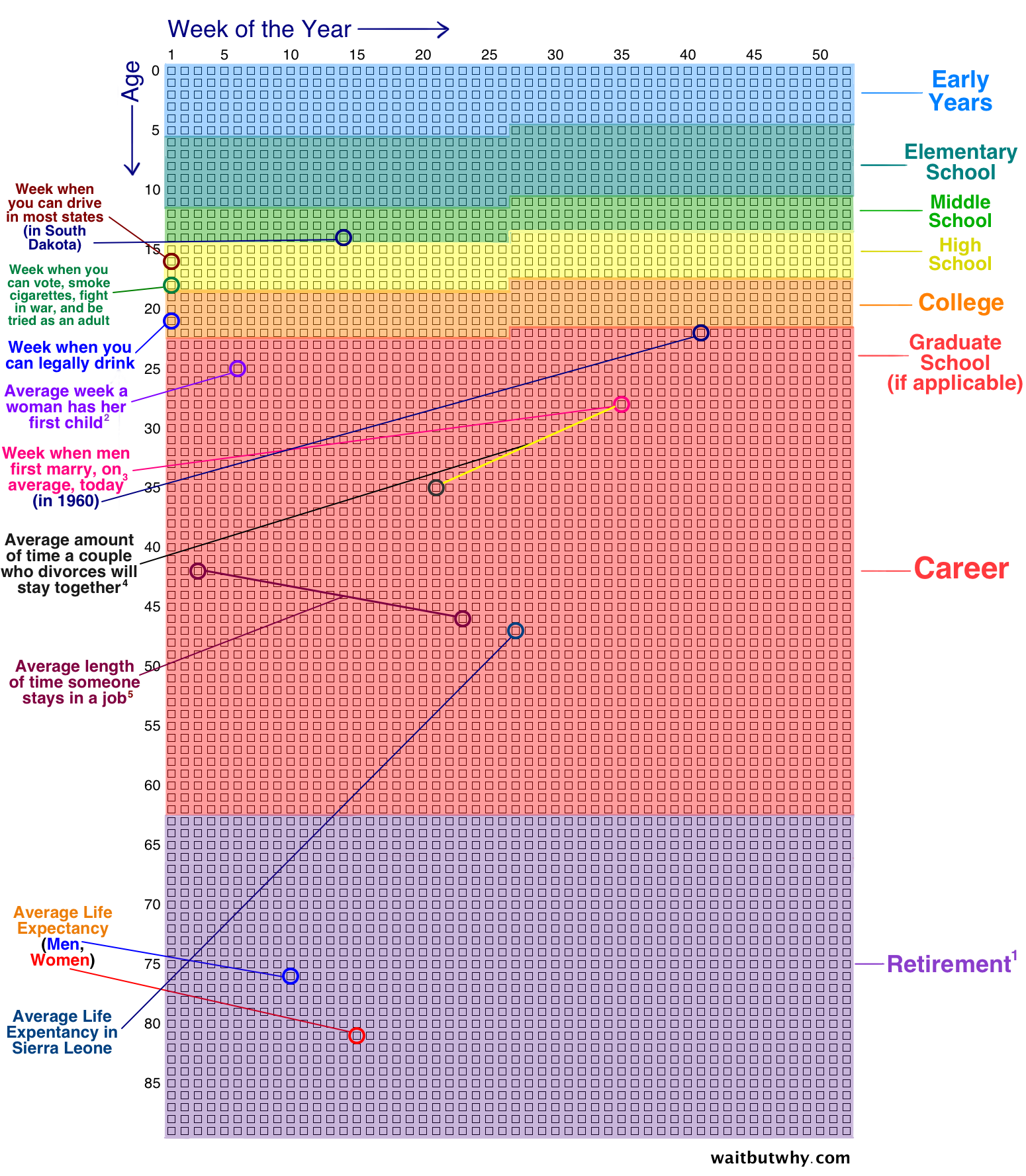 WaitButWhy (2014)